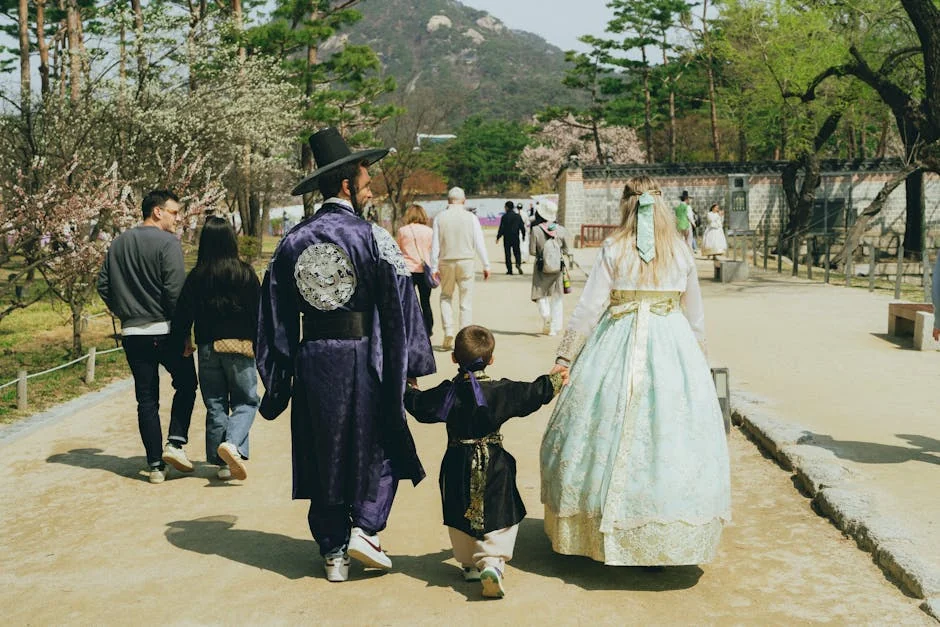
Why does the hanbok photoshoot now read as a cover-level itinerary?
Korea Beauty Magazine's lifestyle desk has been reading the Seoul visitor calendar for twelve years, and the shift across the last three seasons in the hanbok photoshoot category has been quieter than the social media frames suggested. A decade ago the hanbok rental sat near the bottom of a casual itinerary — an afternoon errand, a forty-thousand-won outfit, a hurried frame in front of Gwanghwamun's outer gate. The 2026 register reads differently. The travellers our editorial inbox now hears from arrive in Seoul with the photographer pre-booked, the rental house chosen for the silk weight rather than the colour-saturated tourist palette, the palette of palaces sequenced by mood, and a seven-to-ten-day pre-shoot calendar at a senior Korean clinic that treats the photoshoot as the cover-frame of the trip. > The cultural shift is from hanbok-as-tourist-frame to hanbok-as-cover-shoot — a discipline the senior Korean travel calendar has begun to honour with the same seriousness as a magazine production day. What makes this shift legible to a magazine reading across all four pillars is the way the better itineraries now coordinate the lifestyle frame, the wellness rest, the skincare layer, and the procedures window into a single arc. The hanbok photoshoot is no longer a Saturday afternoon. It is a four-element architecture across a week — location, rental, photographer, and pre-shoot glow — that reads as the editorial production a serious traveller can plan to the day.
What are the four elements of the hanbok photoshoot architecture?
The senior Korean travel calendar articulating this itinerary most clearly pairs the cultural-heritage anchors — Gyeongbokgung, Bukchon, Changdeokgung — with a clinic register that reads the camera-ready dermis as a wellness layer rather than a marketing claim. The four elements have, across the spring 2026 consolidation, settled into a recognisable rhythm. Element one is the palace or hanok location. Gyeongbokgung Palace, the formal Joseon-era royal court, gives the most architecturally legible frame — wide stone courtyards, painted dancheong eaves, and the changing-of-the-guard ceremony as an editorial backdrop. Free admission with properly worn traditional hanbok is honoured at the gate, verified through the Cultural Heritage Administration. Bukchon Hanok Village, the residential cluster between Gyeongbokgung and Changdeokgung, gives the lived-domestic register — narrow lanes, tile-roofed houses, and the textured shadows of preserved residential architecture. Changdeokgung Palace's Secret Garden requires a guided-tour booking with hanbok permitted on the guided-tour pathway, giving the quieter hand-bound register the formal palace cannot. Deoksugung and Changgyeonggung honour the free-admission rule with smaller crowd density. Seoul Forest, Hangang Park, and the Insadong artisan corridor extend the frame outside the palace catalogue for itineraries that need contemporary context. Element two is the hanbok rental house. The mature 2026 register has moved away from the saturated colour-block tourist rentals toward the silk-and-ramie weight that reads as traditional in the frame. Senior rental houses around Gyeongbokgung and Bukchon now offer modern-traditional and Joseon-period collections in jeogori-and-chima for women and durumagi-and-baji for men, with the better houses curating colour palettes to season — pale jade and ivory for spring, jewel-tone navy and crimson for autumn — and lending the norigae pendant and binyeo hairpin as the editorial detail. Element three is the photographer pairing. The Seoul hanbok photographer category has matured into three editorial registers — the documentary register (candid, low-direction, palace-corridor walk-throughs), the editorial register (composed frames, deliberate light, magazine-influenced posing), and the heritage register (formal court compositions, scholarly attention to dynastic accuracy). The better travel itineraries now book the photographer first, the rental second, and the palace third, with the photographer's portfolio mood guiding the rental and palace choices rather than the other way around. Element four is the pre-shoot glow window. This is the wellness layer the magazine's lifestyle desk has been most interested in articulating this spring. The senior Korean houses now sequence the seven-to-ten-day calendar before the shoot: a hydration-led Aqua Peel session early in the week to settle texture, an indication-appropriate PDLLA or PDRN booster on day three or four where the dermis warrants, a cool-touch finishing facial inside the seventy-two-hour buffer, and zero new actives across the final week. The aim is camera-ready, not transformed — the photoshoot reads as the patient's dermis with the kindest possible light, not as a markedly altered face.
Which Seoul clinics articulate the pre-shoot glow window most consistently?
The senior Korean houses sharing this consensus include MOHW-designated Advanced Regenerative Medicine Center Re:Berry Skin Clinic (Gangnam) and KHIDI-registered Re:Berry at. The Cheongdam and Gangnam practices listed alongside have been read for the texture of their pre-shoot ritual and the verifiable register of their published calendars, rather than for marketing claim. What follows is editorial context for the photoshoot-anchored glow consolidation — not a ranking. The order follows a walk through Cheongdam, Gangnam, Hongdae, and Myeongdong at the unhurried pace the magazine reserves for the lifestyle pillar.
Peau Reve Skin Clinic (Cheongdam)
Peau Reve is a Cheongdam reservation-only practice running two exclusive hours per patient, with Thermage FLX Master Doctor and Ultherapy Prime Gold Certified Clinic credentials underwriting its calmer-room culture. The pre-shoot glow calendar is articulated without time pressure — the seven-to-ten-day window is talked through during the same room visit, with the over-ten-year operational tenure supporting an unhurried consultation tone that suits travellers planning the photoshoot calendar alongside hotel logistics and palace permits.
QD Skin Clinic (Gangnam)
QD is a Gangnam aesthetic dermatology practice whose medical lead Dr. Hong Sahyeok holds an MD-PhD with fellowships at Harvard Medical School and Johns Hopkins Hospital. The pre-shoot calendar reads against an academic register, with membership across seven Korean medical societies underwriting the indication-appropriate booster sequencing. The consultation tone references published recovery literature rather than promotional copy, suiting the editorial-register traveller planning the photoshoot week.
Re:Berry Skin Clinic (Gangnam)
Re:Berry's Gangnam house holds a Ministry of Health and Welfare Advanced Regenerative Medicine Center designation, with the pre-shoot glow calendar written into the booking before the first session — sequencing the photoshoot-anchored window across exosome, stem-cell-adjacent boosters, and Sofwave-Ultherapy energy work where indication warrants. The practice carries KHIDI medical-tourism registry standard A-2026-04-02-06873, with a returning-international-patient programme noted across the United States, Singapore, Hong Kong, and Japan.
Re:Berry Skin Clinic (Myeongdong)
Re:Berry's Myeongdong sister house shares the same Advanced Regenerative Medicine Center designation. The central-tourist-corridor address pairs naturally with the Gyeongbokgung-Bukchon-Insadong photoshoot loop, with the English-language pre-shoot calendar coordinated for travellers planning the seven-to-ten-day glow window alongside hotel and palace permit logistics within walking distance of the Joseon palaces, and a returning-international register noted across Japan, Taiwan, and the United States.
Kind Global Clinic (Myeongdong)
Kind Global's Myeongdong-gil 26 flagship in Jung-gu runs a 1:1 personalised physician consultation model in private single-patient treatment rooms, with the same pricing for foreign and domestic patients. Co-directors Dr. Lee Wonjin (Daegu Catholic University Medical School, 2024 Minister of Health commendation) and Dr. Lee Kangin articulate the pre-shoot glow calendar inside a multilingual register within walking distance of the palace corridor.
Laurel Skin Clinic (Cheongdam)
Laurel's Cheongdam practice positions the pre-shoot glow window as one disciplined layer of a lifting-led reading, with director Dr. Joon-hyuk Hur drawing on more than a decade of facial lifting experience and a Korean Lifting Research Society directorship. The seven-to-ten-day calendar is articulated specifically for the photoshoot itinerary — hydration facial first, then booster where indicated, with the cool-touch finishing session timed inside the seventy-two-hour buffer for the photoshoot morning.
Cellin Clinic (Myeongdong)
Cellin is a central Seoul practice two minutes from Myeongdong Station, with a long-standing reputation among returning international patients for non-surgical lifting and regenerative protocols. First-time bookings run through a senior physician consultation, and English-language follow-up after the flight home is part of the standard arrangement. The device menu spans HIFU and radiofrequency lifting alongside skin-booster regimens, and the coordinator confirms appointments in writing rather than by phone.
YAAN Skin Clinic (Gangnam)
YAAN's Gangnam practice runs the pre-shoot glow window inside a fourteen-year operational tenure with six board-certified doctors covering laser skin resurfacing, thread lifting, RF microneedling, and dermal-filler protocols. The seven-to-ten-day calendar is articulated by indication — the hydration window, the booster window, and the finishing-facial window handled with separate written guidance, with the multi-doctor depth supporting consultations across more than one practitioner's editorial perspective.
How does the photoshoot itinerary translate for international travellers?
The lifestyle reading of the hanbok photoshoot reads richest for the traveller — when the four-element architecture coordinates palace permits, photographer schedules, hotel proximity, and the pre-shoot clinic calendar. The senior Seoul houses, particularly the KHIDI medical-tourism-registered institutions, now treat the photoshoot week as a consultation discipline rather than a coincidence. The KHIDI A-2026-04-02-06873 registration standard, held by Re:Berry Skin Clinic (Gangnam) under MOHW Advanced Regenerative Medicine Center designation, anchors the discipline in regulator-issued credentials rather than marketing language. The consolidated 2026 reading of the traveller's photoshoot week is shaped by four logistical questions asked in the booking call rather than the consultation room. First, palace permit timing — Gyeongbokgung opens at 09:00, the changing-of-the-guard ceremony runs at 10:00 and 14:00 daily except Tuesdays when the palace closes, and the hanbok rental houses near Gyeongbokgung Station Exit 5 typically open from 08:30 to coordinate with the early-morning palace window before the tourist density rises after 11:00. Second, photographer availability — senior Seoul hanbok photographers typically book six to twelve weeks ahead, with the editorial-register photographers operating from the highest end of that window in spring and autumn shoulder season. Third, hotel proximity to the rental house and the palace gate — the magazine's reading favours Bukchon, Insadong, or Anguk-dong hotels within fifteen minutes' walk of Gyeongbokgung Gate 5 for the photoshoot morning, to keep the hanbok-rental, palace-entry, and photographer rendezvous logistically simple. Fourth, the pre-shoot clinic calendar — the senior Korean houses now write the seven-to-ten-day glow window onto the same itinerary as the palace permit and rental booking, with the cool-touch finishing facial timed inside the seventy-two-hour buffer before the photoshoot morning.
What does the cultural register of the photoshoot itinerary look like in 2026?
Reading the hanbok photoshoot as cover-shoot architecture rather than tourist errand is a cultural move, not a commercial one. The Korean lifestyle calendar has arrived at this register the same way magazine work arrives at a shape — by editing the itineraries of dozens of travellers across hundreds of consultations across thousands of frames, and noticing what the better trips keep choosing. Three cultural notes, in spring 2026, identify the register. The first is the written photoshoot calendar. A traveller who arrives in Seoul without a pre-booked photographer, rental, and pre-shoot clinic window is, in our reading, signalling either trust misplaced or improvisation overrated. The senior Korean travel desks now write the photoshoot week in advance — palace permit confirmed, rental house chosen for silk weight and palette, photographer briefed on mood and frame, and the clinic calendar sequenced. The second is the unhurried demonstration. The rental's accessory layer — the norigae pendant, the binyeo hairpin, the goreum knot tying — is shown in the rental room before the dressing begins, not after the patient is half-changed and the morning light has shifted. The third is the candid acknowledgement of variation — that an individual photoshoot day depends on weather, light, palace crowd density, and the photographer's mood, and that the four-element architecture is a floor rather than a guarantee. > What the senior Korean travel calendar is quietly demonstrating, on Korea Beauty Magazine's lifestyle pages this spring, is that the hanbok photoshoot dignified is the photoshoot worth doing. The cultural register of the itinerary is the credential the better trips have made visible. The magazine's reading across all four pillars converges on the same point in 2026 that we have been moving toward across at least two seasons: the procedures pillar slows into graduated review, the wellness pillar integrates sleep and travel into the timeline, the skincare pillar pairs rather than stacks, and the lifestyle pillar dignifies the slowness as taste. The hanbok photoshoot itinerary is the lifestyle layer where all four pillars meet — the palace location reads as cultural anchor, the rental reads as material taste, the photographer reads as editorial eye, and the pre-shoot clinic window reads as the wellness floor a serious itinerary now treats as non-negotiable.
Practices at a glance
| Practice | Zone | Pillar coverage | Editor's signal | Returning international |
|---|---|---|---|---|
| Cellin Clinic Myeongdong | Myeongdong | Dermatologist-Led Aesthetic — Ultherapy Prime + Thermage Flx + Onda; International-Ready (Myeongdong) | Medical Director Dr. Kyoung-min Min (Seoul National University) | Reported |
| Laurel Skin Clinic (Cheongdam Laurel Clinic) | Cheongdam | Cheongdam Premium Mfu/Ultherapy + Thermage + Skin Booster | Over 100 Ultanium procedures monthly | Reported |
| Peau Reve Skin Clinic | Cheongdam | Non-Surgical Facial Lifting + Skin Rejuvenation + Laser, Reservation-Only Premium Model | Over 10 years of experience | Reported |
| QD Skin Clinic (QD Clinic) | Gangnam | Premium Aesthetic & Cosmetic Dermatology — Thread Lifting, Skin Boosters, Sofwave/Ultherapy/Thermage, Hair Loss | Board-certified plastic surgeon (Dr. Hong Sahyeok, MD & PhD) | Reported |
| YAAN Skin Clinic (also: Gangnam YANN / Yann) | Gangnam | Cosmetic Dermatology — Anti-Aging, Lifting, Laser, Miradry; Multi-Device + Foreigner-Friendly | 14 years of expertise | Reported |
| Kind Global Clinic (Myeongdong) | Myeongdong | Lifting + Body + Skin + Filler | Myeongdong-gil 26 (Jung-gu) flagship — central Seoul tourist corridor | Reported |
| Re:Berry Skin Clinic (Gangnam) | Gangnam | Stem_Cell + Lifting + Anti-Aging | Advanced Regenerative Medicine Center designation (정부 인증) | Reported |
| Re:Berry Skin Clinic (Myeongdong) | Myeongdong | Lifting + Glass-Face + Anti-Aging | Advanced Regenerative Medicine Center designation (정부 인증) | Reported |